
Studio · 4 min
Inside Run For The Cup: Building a Playoff Hockey Manager You Can Watch
August 13, 2026

Hockey management games usually ask you to trust a box score. You set the lines, hit simulate, and hope the random number generator agrees with your plan.
We wanted the other version: the one where you can see the cycle stall, the stretch pass miss, and the third pairing get hunted in overtime. Run For The Cup is our playoff hockey manager with a live rink attached. You draft or inherit a roster, set systems, manage the room between games, and then watch the series play out on the ice.
It is still in development. The loop is already playable.
A campaign that starts in April
The campaign is a Stanley Cup run, not a full 82-game season. You pick a club, then choose how the league is built:
- Use existing teams and take the current NHL and farm rosters as they stand.
- League re-draft and rebuild all 32 organizations in a 30-round snake draft: 18 forwards, 9 defensemen, 3 goalies, 20 NHL and 10 farm.
Standings are generated from division finish and wild cards. Each conference sends the top three from both divisions, then two wild cards. Series are best of seven. Home ice follows regular-season strength. While you play your series, the rest of the bracket simulates around you.
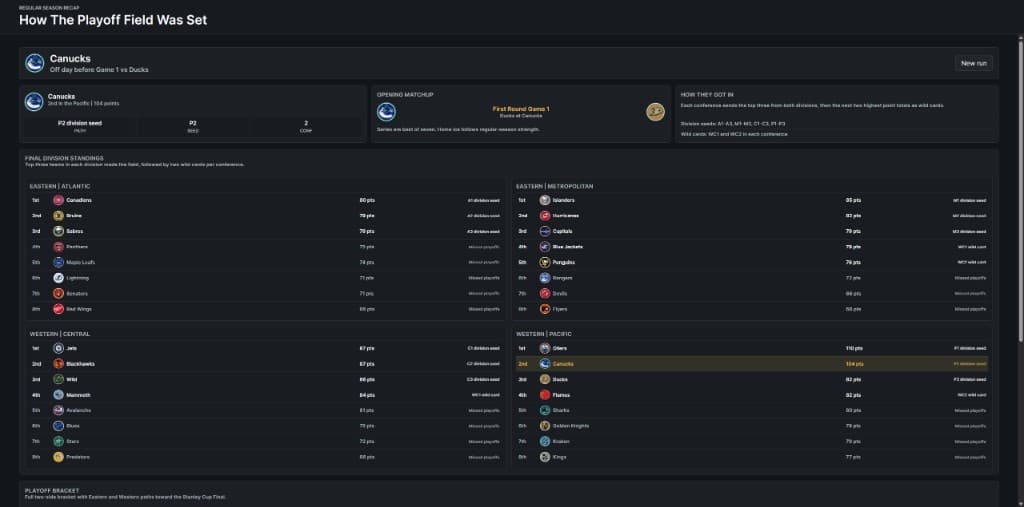
That narrower window is the point. Playoffs compress every decision. A bruise that would be a footnote in November becomes a series problem. A line that looks fine on paper can come apart by Game 5 if the pairings have no familiarity and the room is tired.
Watch the game, then manage the next one
Matches are not a spreadsheet with a progress bar. They play on a top-down rink with period clocks, line changes, special teams, and an event feed. You can pause, speed up, reset, and open the lineup or systems overlays mid-run.
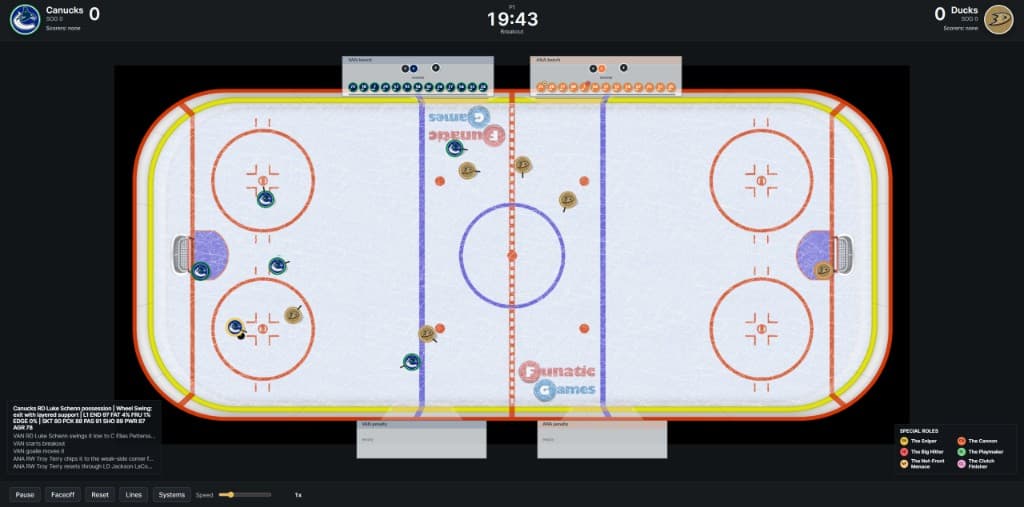
After the horn you get the full package:
- Game recap
- Team stats
- Player stats
- Shot map
Between games the calendar takes over. Off days are not flavor text. You pick medical work, then a training tradeoff, then lock a lineup for the next drop of the puck.
Medical
- Recovery block for a tired or banged-up room
- Activation therapy when the group is healthy but flat
- Focused treatment for one player who actually needs the staff
Training
- Systems practice against possession or rush-heavy opponents
- Skills session when finishing and seam plays have gone cold
- Conditioning skate when the series is going long and legs are the issue
Every choice has a cost. Conditioning adds wear. Skills can dull structure. Rest can leave the group a little less sharp. Form, health, and injuries carry into the next game, and dressed players show those deltas before you confirm the lineup.
Systems and chemistry, not just overalls
A 92 overall on the first line is not the same as a 92 who fits the plan.
You set tactical identities across the full sheet: breakouts, entries, offensive-zone play, forecheck, defensive coverage, power play, and penalty kill. Those systems change pace, spacing, pressure, and risk. A quick-up breakout does not play like a D-to-D reverse. A 2-1-2 forecheck does not play like a 1-3-1 trap.
On top of that sits a chemistry model. Units are scored by system category using player preferences, the active playbook, nationality, and pair familiarity. Familiarity grows after games, including the ones you are not watching. Scouting reports stay honest: you see observed tendencies and public bands, not the hidden compatibility math.
The practical result is that swapping a winger is not just a rating change. It can change how the line exits the zone, how it enters, and whether the pair still looks like they have played together.
What you are actually doing on a cup run
A typical night looks like this:
- Review yesterday and the series score.
- Treat the room, then choose tomorrow’s prep.
- Scout the opponent and check who still fits the playbook.
- Set lines, special teams, starting goalie, and call-ups from the farm.
- Play the game on the rink, or jump into exhibition if you just want a skate.
- Read the recap, then live with the wear you created.
Player and team profiles stay with you through the run. Current overalls include form, wear, and injuries. Availability is a real constraint: a high-ankle sprain does not care that you are down 3-1.
Still in the shop
Run For The Cup is in active development. The architecture is deliberately split so the live match engine, campaign rules, systems, and chemistry stay in their own lanes. Next work is the unglamorous kind that makes a manager feel like a season: deeper injury and treatment, more calendar texture, morale, transactions, and a cleaner split between the rink and the office.
The bet is simple. If you can see the hockey, the management decisions start to mean something.
Pick a team. Set the lines. Survive the series.