
Development / Tools · 6 min
Building Sunder: An Artist-First Approach to 3D Destruction
August 10, 2026
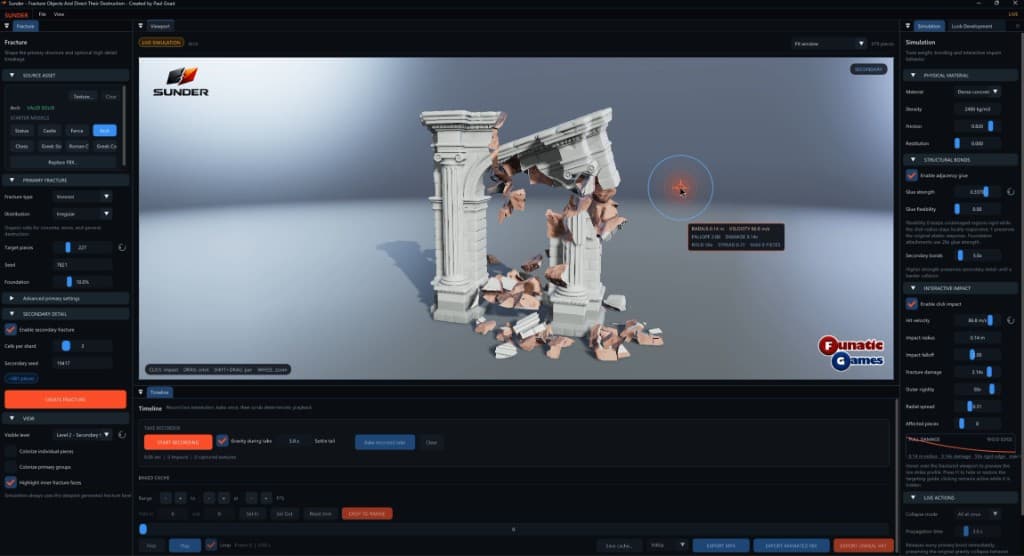
Fracture objects and direct their destruction
Destruction can add an enormous amount of weight and spectacle to a scene, but authoring it is often a fragmented process. Geometry may be prepared in one application, fractured in another, simulated elsewhere, and finally passed through a custom export pipeline before it can be used in a game engine.
Sunder is being created to bring those stages together.
It is a native Windows application for importing 3D objects, procedurally fracturing them, directing their destruction, recording simulations, and exporting the finished result to game engines and digital content creation software.
The objective is not simply to make objects break. Sunder is intended to give artists control over the story of that destruction: where the damage begins, which areas remain supported, how the collapse propagates, and how the final motion is delivered to another application.
Why I started building Sunder
I have spent nearly 30 years creating video games, working as an artist and art director on projects including Need for Speed, Luigi’s Mansion, Age of Empires IV, and Squad.
Throughout that time, I have remained driven by the same things that originally brought me into the industry: creating, experimenting with ideas, building worlds, and finding better ways to turn artistic intent into something interactive.
Sunder is a continuation of that passion.
Destruction tools are often technically impressive but can feel as though they were designed around the needs of the simulation rather than the needs of the artist. My goal with Sunder is to create a focused authoring environment where complex destruction remains approachable, visual, responsive, and directable.
More than one way to break an object
Different materials and structures do not fracture in the same way. A stone statue, brick wall, wooden fence, and architectural column each require different patterns of damage.
Sunder therefore provides several procedural fracture systems:
- Voronoi fracture for irregular stone, concrete, and general destruction
- Plane slicing for layered or directional breaks
- Orthogonal grids for block-like structural divisions
- Radial impact fracture for damage concentrated around a central strike
- Brick fracture for staggered masonry patterns
- Long plank fracture for wooden beams and boards
- Secondary splintering for finer breakage along wooden grain
The artist can control the target fragment count, random seed, distribution, direction, variation, foundation height, and secondary fracture detail.
Generated inner faces are automatically filled with geometry and assigned their own interior material treatment. This prevents broken pieces from looking like empty shells and makes exposed surfaces read as stone, concrete, aggregate, limestone, granite, or another appropriate material.
Primary and secondary destruction
One of Sunder’s central systems is hierarchical fracturing.
An object can first be divided into larger primary fragments. Each primary fragment can then contain a secondary fracture structure that remains bonded until it experiences a sufficiently intense collision.
This produces a more believable progression of damage. Large pieces may separate during the initial collapse, then break into smaller debris when they strike the ground or collide with another object.
The result is destruction with more variation and visual history. Instead of every fragment being released simultaneously, the structure can continue to break apart as energy moves through it.
Directing the collapse
A structure does not always need to collapse everywhere at once. Sunder currently provides three gravity-collapse modes:
- All at once releases the structure in a conventional gravity collapse.
- Top down begins destruction near the top and progressively travels downward.
- Bottom up removes lower support first, allowing the upper structure to descend into the failing base.
Progressive collapse controls allow the event to unfold over time instead of becoming a single instantaneous release. This helps give the destruction a readable beginning, middle, and end.
Physical properties such as density, friction, restitution, glue strength, glue flexibility, secondary bond strength, and ground-impact damage can be adjusted to suit the material and scale of the object.
Interactive impact damage
Sunder also allows the artist to strike the fractured model directly in the viewport.
A click creates a localized impact with adjustable properties:
- Hit velocity
- Impact radius
- Radial falloff
- Fracture damage
- Radial spread
- Outer structural rigidity
- Maximum affected fragments
The goal is to keep damage concentrated near the selected point. Fragments closest to the strike receive the greatest damage, while bonds farther away become progressively more resistant.
This makes it possible to chip away at a structure, open a localized hole, or weaken several areas before triggering a larger collapse.
Visual targeting indicators show the current impact radius and damage profile, allowing the artist to understand the effect before applying it.
Protecting parts of a fractured model
A recent addition to Sunder is rigid-region authoring.
After an object has been fractured, the artist can window-select fragments directly in the viewport and mark them as rigid. Window selection passes through the complete fractured volume, making it possible to select both visible and hidden fragments.
This supports workflows such as creating a destructible hole in a wall. Fragments surrounding the intended damage can be fixed in place while the central region remains dynamic and vulnerable to impact.
Selections can be replaced, added to, or subtracted from. Rigid assignments can also be removed later without refracturing the object.
This system provides another layer of artistic control: destruction can be limited to the part of the structure that matters to the shot or gameplay event.
Recording and baking simulations
Interactive destruction is useful during experimentation, but production requires repeatable results.
Sunder can record a live simulation—including gravity, collisions, and interactive impacts—and bake the resulting rigid-body transforms into a deterministic timeline.
Once baked, the simulation can be:
- Played without rerunning physics
- Paused and scrubbed frame by frame
- Trimmed at the beginning and end
- Rebased so the retained animation starts at frame zero
- Saved as a reusable simulation cache
- Rendered directly to an MP4 movie
This makes it possible to experiment freely during authoring and then preserve the exact result that worked.
Exporting to Unreal Engine and DCC applications
Sunder currently provides two major animation-export workflows.
Unreal Engine Vertex Animation Textures
The Unreal export creates a rigid-body Vertex Animation Texture package containing:
- A fractured GLB static mesh
- Packed fragment identifiers
- Full-precision position data
- Full-precision rotation data
- Position and rotation textures
- Outer and inner material assignments
- Generated HLSL code
- A package-specific Unreal Engine setup guide
VAT playback moves the fragments on the GPU using material-driven animation. This avoids the need to create thousands of conventional bones and can be an efficient way to play complex baked destruction inside Unreal Engine.
Animated rigid-piece FBX
Sunder can also export an animated FBX with one mesh node per fragment and baked translation and rotation keys.
This format is intended for applications such as 3ds Max and other DCC packages where the destruction may need additional editing, rendering, compositing, or integration into a larger scene.
The animated FBX pipeline is separate from the Unreal VAT exporter, allowing each workflow to evolve without interfering with the other.
Look development and presentation
Although Sunder is primarily an authoring tool, presentation matters. It is much easier to judge a fracture when the model, materials, shadows, interior surfaces, and debris contacts are clearly visible.
The viewport includes:
- HDR environment lighting
- Adjustable key lighting
- Soft shadows
- Exposure and material controls
- Procedural inner-fracture materials
- Outer texture support
- Enhanced ambient occlusion
- Multiple viewport aspect ratios
- Direct MP4 export
Ambient occlusion strengthens carved details, fracture seams, overlapping fragments, and contact with the floor. This helps intact and fractured models retain depth while they are being evaluated.
Viewport aspect-ratio presets include traditional desktop, tablet, phone, cinematic, anamorphic, square, and social-media formats. A clean-view hotkey can hide interface overlays while retaining the Sunder and Funatic Games branding.
Building a focused destruction tool
Sunder is still in active development. Its systems continue to be refined through practical tests involving statues, walls, fences, arches, columns, castles, and other architectural objects.
The most important development priorities are reliability, performance, predictable physical behavior, and preserving the artist’s intent from fracture through export.
There is still more work ahead, but Sunder has already grown into a substantial destruction-authoring environment. It can import custom assets, generate several fracture styles, simulate progressive collapses, apply localized impacts, protect rigid regions, record live interactions, bake deterministic animation, and export the results for use elsewhere.
Ultimately, the vision is straightforward:
Give artists a dedicated place to fracture objects, direct their destruction, and move the result into production.