
Close Encounters · 7 min
Building Close Encounters of the Herd Kind: Small Planet, Big Personalities
September 10, 2026
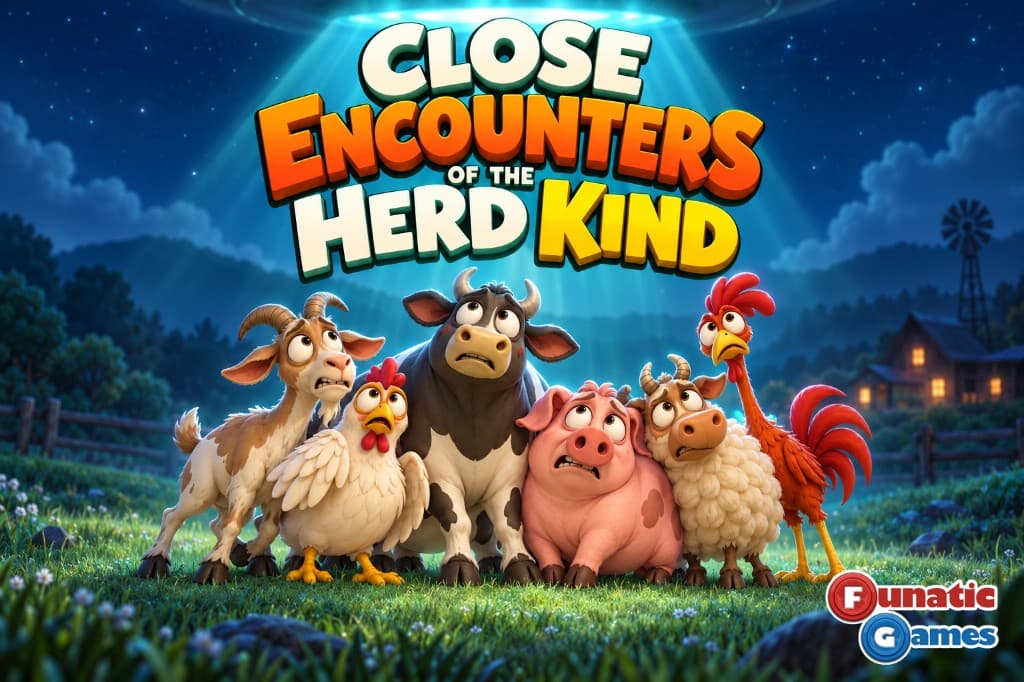
The animals have other plans
You’ve almost done it. The chicken is heading towards the mothership. The cow is waiting nearby. Your next collection looks straightforward.
Then the chicken rejoins its friends.
You move around to separate it again, accidentally encourage the cow, and suddenly your carefully organised approach becomes an impromptu farmyard evacuation.
That is the kind of moment we want Close Encounters of the Herd Kind to create: a small, understandable challenge that turns into a funny story because of what the player—and the animals—did.
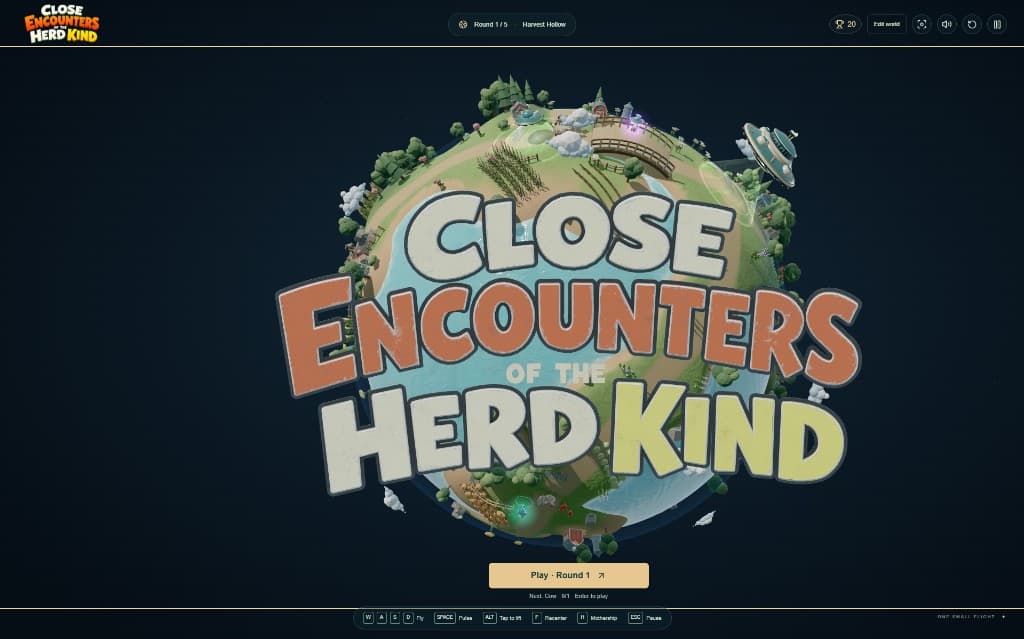
At Funatic Games, we’re building an arcade herding game set on a colourful little planet. You pilot a UFO, guide animals towards your mothership and try to collect the right passengers in the right order. The premise is deliberately simple. The depth comes from learning how to manage a world that keeps moving.
A simple action with room to master
The heart of Close Encounters is the relationship between your UFO and the animals beneath it.
Your position matters. Approach from one side and you encourage an animal towards its destination. Approach from the wrong angle and you might scatter the group, steer a passenger towards trouble or bring the wrong animal into the collection area.
We want players to understand that relationship quickly. From there, the game can introduce more interesting situations without continually adding new controls.
A narrow crossing changes how you approach a herd. An isolated island makes you reconsider which power-up to save. A crowded collection area turns a straightforward delivery into a test of patience and precision.
Our goal is to make improvement feel tangible. A situation that once caused a scramble should eventually become something you can handle with a few deliberate movements.
Why collection order changes everything
One of the most important development decisions has been moving beyond a simple “collect enough animals” objective.
A total encourages players to gather whatever is nearby. A collection sequence asks them to make choices.
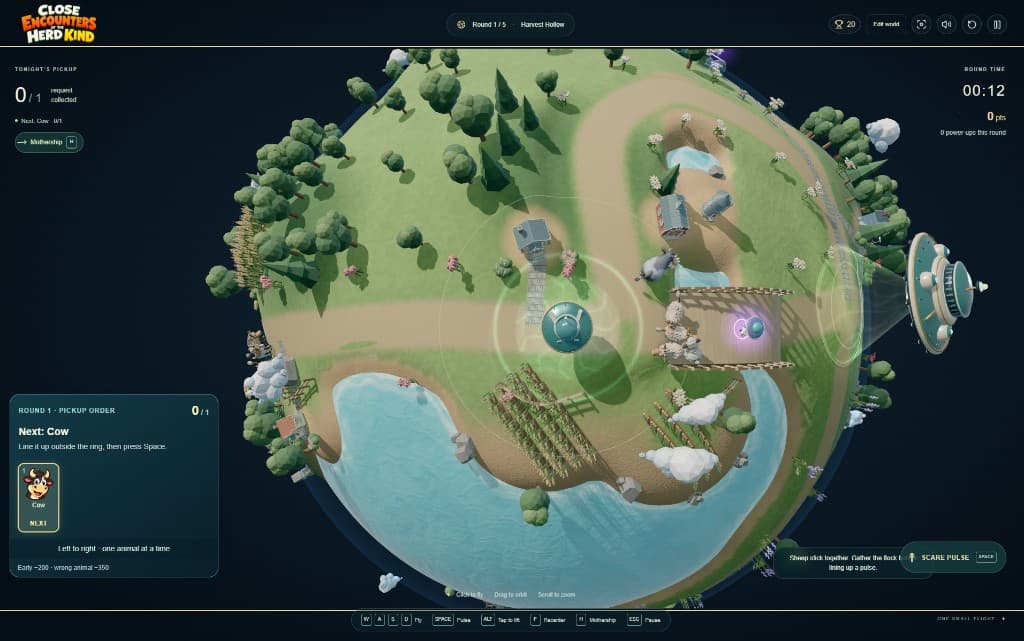
If the mothership needs a chicken, followed by a cow, followed by a goat, pushing the entire herd towards it is unlikely to end well. You need to identify your next passenger, separate it from its companions and create a clear route aboard. Incorrect deliveries cost points.
That adds several connected challenges:
- Observation: Where is the animal you need next?
- Planning: Which route gives you the best chance of delivering it cleanly?
- Control: Can you separate one passenger without scattering everyone else?
- Recovery: What will you do when the situation changes?
The sequence also needs to be easy to follow. Cute animal portraits show the requested order, and captured versions mark your progress. The interface should make the next decision obvious while leaving your attention on the world.
The design goal is thoughtful herding with enough unpredictability to keep each delivery interesting.
Push, pulse and lift
Different animals should create different problems, so they shouldn’t all board the mothership in exactly the same way.
The standard beam lets you guide animals around the landscape. A pulse gives you a stronger intervention, and larger passengers require that extra encouragement to board. The bull takes things further: it needs to be lifted in.
The lift power-up is a useful example of how we want abilities to work. Once collected, it stays available until you choose to activate it. A tap of Alt switches you into lift mode, letting you pick up one animal and carry it for a limited time.
That creates a decision with a clear consequence. Do you spend the lift now to recover a stuck animal, or save it for a passenger stranded across the water?
It also gives us a new opportunity for character. Being unexpectedly carried by a UFO deserves a reaction. Pickup, airborne and landing animations help turn a practical tool into a memorable interaction.
Power-ups need to communicate their purpose visually, too. We’ve been improving their models, increasing their visibility and strengthening their glow so players can recognise useful opportunities while navigating the planet.
Personality is part of the gameplay
An animal can have an idle animation and still feel strangely lifeless.
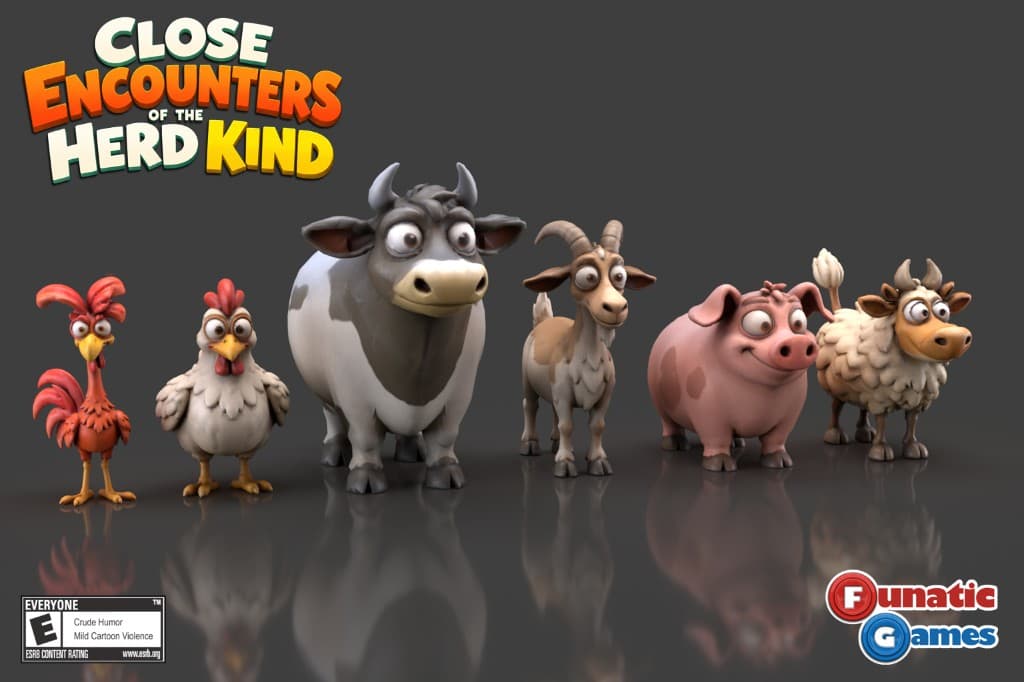
To give the farmyard more character, we’ve been developing reactions that connect to what is happening around each animal. Sheep briefly celebrate returning to their flock. Pigs shake off mud when they reach dry ground. Goats perch proudly on rocks. Chickens can briefly follow a rooster.
These moments have to earn their place. If an animation constantly interrupts movement or makes an animal difficult to read, it starts working against the herding.
Our guiding principles are straightforward:
- Reactions should be noticeable at the normal gameplay camera distance.
- Different species should have recognisable behaviour and movement.
- Personality moments should stay short.
- Important gameplay actions should take priority over decorative animation.
The expanding cast gives us plenty to work with. Bulls, fluffy sheep, geese, rabbits and turkeys join the existing animals, bringing different silhouettes and opportunities for expression. Rigging, skinning and animation support that variety, but the real test is how clearly those differences come across during play.
We want players to recognise individuals through their behaviour—and occasionally develop a friendly grudge against the one that keeps escaping.
Making difficulty feel earned
Early rounds need to give new players room to understand the beam, the collection order and the landscape.
That means looking closely at apparently small details. Widening an early bridge can make the difference between a useful introduction and an unnecessarily frustrating obstacle. Clear icons can prevent a delivery mistake that has nothing to do with the player’s herding ability.
Later rounds can ask for more. Animals separated from the group and left away from the UFO become more likely to flee as the challenge increases. The player has to pay attention to stragglers and decide whether to pursue them or finish the current delivery.
Our aim is for difficulty to come from managing competing priorities. Players should be able to understand what went wrong and imagine a better approach on their next attempt.
Finding that balance will remain an important part of development.
A world that feels alive—and stays readable
The planet’s presentation has a practical job as well as an artistic one.
Grass, sand, snow and water should be distinct enough to understand at a glance, while still belonging to the same playful world. We’ve been refining surface detail and blending, reducing obvious texture repetition and giving materials more of their own identity.
Snow needs a little sparkle. Sand needs grain and variation. Swimming animals should sit partly beneath the surface and move as though the water is supporting them.
We’ve also been improving rocks, clouds and other scenery. The aim is a cohesive, stylised landscape that frames the action without overwhelming a small animal or hiding an important route.
Some improvements are less immediately visible but just as important. Overlapping roads need stable layering so they don’t swap appearance as the camera moves. The opening and departure sequences should ease naturally from the existing view, keeping the player connected to the planet.
These details accumulate. A convincing world depends on many small systems agreeing with one another.
The world editor is also a design tool
The world editor is an important part of Close Encounters, both as a creative feature and as a way to explore what makes a good herding challenge.
Starting with a blank grass planet, you can shape terrain, paint surfaces and place animals, scenery and obstacles. A broad land connection can create a forgiving route. A carefully placed bridge can test precision. An isolated island can give the lift power-up a clear purpose.
That flexibility helps us ask useful design questions:
- Does this layout encourage a decision or simply slow the player down?
- Can the next objective be understood from the gameplay view?
- Is there enough room to separate animals?
- Can a mistake lead to an interesting recovery?
We’re also investigating finer terrain sculpting. More detail can give creators greater control, but adding geometry across the entire planet has a performance cost. The direction we want to explore is detail where it is needed, supported by measurements rather than simply increasing everything.
The editor should make experimentation approachable while keeping the resulting worlds responsive to play.
What success looks like
Close Encounters of the Herd Kind is still in development. The challenge ahead is bringing its mechanics, animals, world and presentation into a consistent rhythm.
We want a first-time player to understand the basic idea quickly. We want an experienced player to see opportunities for cleaner routes and smarter deliveries. And we want the animals to provide enough personality that even an imperfect round leaves something worth smiling about.
Above all, we want players to finish a round thinking about the moment they nearly lost control, the recovery they somehow pulled off, or the bull they finally managed to get aboard.
A small planet should have room for plenty of stories.